
A rate cut will bring positive sentiment around the Budget.

'If Urjit Patel had resigned after the five-state elections results people would have taken a different view. So this was the right time for him to resign.' 'He rightly resigned as he felt the differences with the government were not getting settled.'

Mr Swamy has written letters to the Prime Minister's Office asking for Mr Rajan's services to be terminated.
RBI data show one-fifth of all the infrastructure loans are stressed and the share of such loans in overall stressed assets is nearly a third.
'We have promised to ensure reduced tax rates.'

A good monsoon could rein in food inflation. Largely good corporate results mean better days are ahead. Nifty may reach record levels, points out Devangshu Datta.
It would be beneficial for the economy to hold on to high interest rates till inflation numbers are under control.

'If the government spends Rs 10 lakh crore this year then you would be looking at a GDP growth of minus 5 per cent.' 'If you do not do this, you will be looking at GDP growth between minus nine and minus 10 per cent.'

Delivering a public speech hours after the RBI launched a rescue act for Yes Bank on March 6, Governor Shaktikanta Das reiterated the RBI's affirmation to do whatever was needed to combat the coronavirus impact. On that day, India had only one confirmed COVID-19 infection, the World Health Organisation was five days off from declaring it as a pandemic and the financially debilitating lockdowns were not even on the horizon. Das' promise on efforts to mitigate COVID-19 impact appeared as a footnote in news reports from the event.

Data on the real value of the currency against other currencies tells a different story.

Inflation is down, growth is headed for recovery. RIL and subsidiary Jio are on an upswing. However, stressed loans and impending job losses are the dark clouds, says Devangshu Datta.
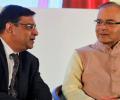
The lack of an informal communication channel is what should bother the government and the RBI, if they want to eliminate the undesirable outcomes of the current tension between the two, says A K Bhattacharya.
The finance minister chided the central bank on Tuesday over its focus on fighting inflation, saying the Reserve Bank of India (RBI) also needed to abide by the government policy to promote economic growth.
Managing expectations is a challenge for policymakers.
Historically, the RBI has tried to keep the crooks at bay by issuing a circular a day. What it needs is more onsite supervision. Merely checking high-frequency data with the help of technology is insufficient, notes Tamal Bandyopadhyay.
The finance ministry has ruled out the proposal for the appointment of a chief operating officer (COO) of the rank of deputy governor in the Reserve Bank of India (RBI), as the government feels no interim arrangements should be made for such high-profile appointments.

Tamal Bandyopadhyay offers some unsolicited advice for a government wh,ich came to power, with brute majority and the nation's pragmatic chief money man.
RBI in wait and watch mode as several risks to inflation continue to exist including a sudden reversal of food prices and oil price volatility.

In India we have to be careful not to copy any level of dependence on the financial sector and infatuation with the get-rich-quick syndrome, says Jaimini Bhagwati.
The corporate sector does not care from where the money is coming.

The majority in the markets believe that a September lift-off is likely.

Over the past week, the Sensex and the Nifty continued the bull-run
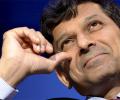
Reserve Bank of India (RBI) Governor Raghuram Rajan spoke on a host of issues at his last post-policy interaction with the media

He endorsed transparency and financial stability in addition to issues related to inclusive growth and development, write Puran Singh and Nupur Pavan Bang.

A total of 183 stocks rallied 10 per cent, of which 32 stocks saw price appreciation of 20 per cent each.

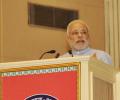
The assessment of PMJDY should be done within the context of the programme.
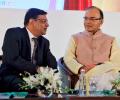
The Financial Stability and Development Council meeting on Tuesday started with an air of tension in the room. An official present described the participants' body language as "tetchy". However, once presentations and discussions begun, the mood considerably eased.

Every political party loves to use the bait of loan waiver to woo the electorate. If their hearts bleed for the poor, they can always use the party funds to pay off the lenders, suggests Tamal Bandyopadhyay.

FY16 GDP growth was seen at 7.5%, against 8.1-8.5% earlier.
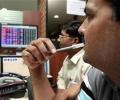
The benchmark BSE Sensex reclaimed the 28,000 mark, spurting by 409 points or 1.4% at 28,114 and Nifty settled above the 8,500 mark at 8,532, gains of 111 points.

'We all wanted a strong Centre with a decisive mandate from the people, to allow them to take bold decisions.'

NITI Aayog vice chairperson Rajiv Kumar tells Indivjal Dhasmana that additional funds could be generated through divestment, and that the fiscal deficit should be widened while focusing on the revenue deficit.

It is surprising that central bankers around the world have cautioned the US Federal Reserve against raising rates.

Chidambaram promises to maintain fiscal discipline; admits inflation is an issue.

This is a terrible situation for a growing economy to be in, and the central bank would be expected to act to correct the situation.

Finance Minister Arun Jaitley on Monday presented the Union Budget for 2016-17.

One of the finest minds on foreign exchange management, monetary and fiscal policies, on debt and currency markets, on bank management and governance, and indeed on almost every aspect of modern finance and banking passes into the ages.

'Rather than cutting and pasting from advanced economies, we should use basic economic principles to think about what is right for India at the stage of development at which we are,' says Chief Economic Advisor Krishnamurthy Subramanian.

Loan waivers will never be enough. Reforming the agricultural marketing system is essential to addressing the concerns of farmers in a sustainable manner, says Nitin Desai.
